publications
2026
-
 Semantic-Geometric Task Representations for Bimanual Manipulation from Human Demonstrations to Robot Action PlanningFranziska Herbert, Vignesh Prasad, Han Liu, Dorothea Koert, and Georgia ChalvatzakiIEEE Robotics and Automation Letters (RA-L), 2026
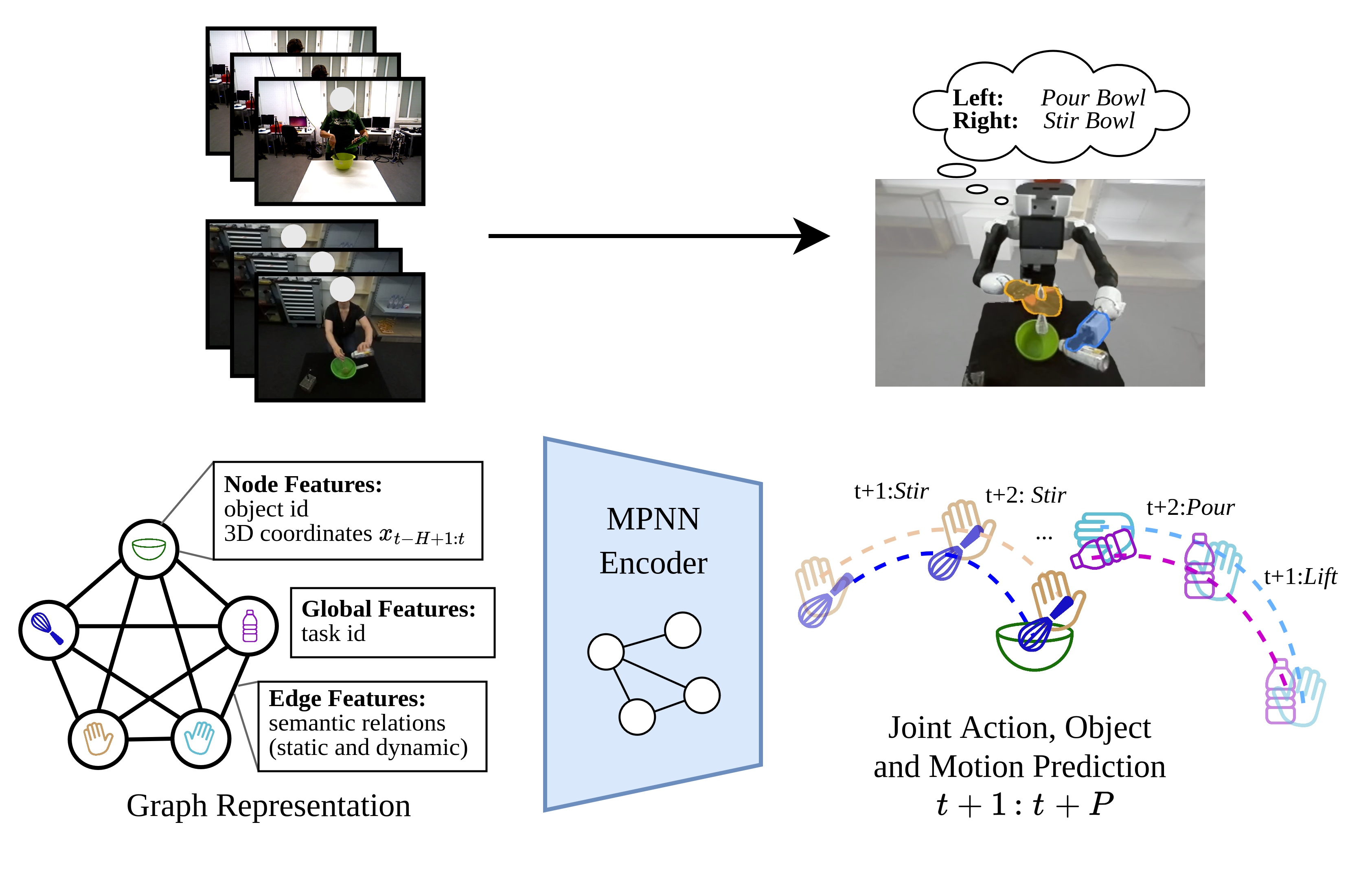
Learning structured task representations from human demonstrations is essential for understanding long-horizon manipulation behaviors, particularly in bimanual settings where action ordering, object involvement, and interaction geometry can vary significantly. A key challenge lies in jointly capturing the discrete semantic structure of tasks and the temporal evolution of object-centric geometric relations in a form that supports reasoning over task progression. In this work, we introduce a semantic-geometric task graph-representation that encodes object identities, inter-object relations, and their temporal geometric evolution from human demonstrations. Building on this formulation, we propose a learning framework that combines a Message Passing Neural Network (MPNN) encoder with a Transformer-based decoder, decoupling scene representation learning from action-conditioned reasoning about task progression. The encoder operates solely on temporal scene graphs to learn structured representations, while the decoder conditions on action-context to predict future action sequences, associated objects, and object motions over extended time horizons. Through extensive evaluation on human demonstration datasets, we show that semantic-geometric task graph-representations are particularly beneficial for tasks with high action and object variability, where simpler sequence-based models struggle to capture task progression. Finally, we demonstrate that task graph representations can be transferred to a physical bimanual robot and used for online action selection, highlighting their potential as reusable task abstractions for downstream decision-making in manipulation systems.
2025
-
 Entropy based blending of policies for multi-agent coexistenceDavid Rother, Franziska Herbert, Fabian Kalter, Dorothea Koert, Joni Pajarinen, Jan Peters, and Thomas H WeisswangeAutonomous Agents and Multi-Agent Systems, 2025
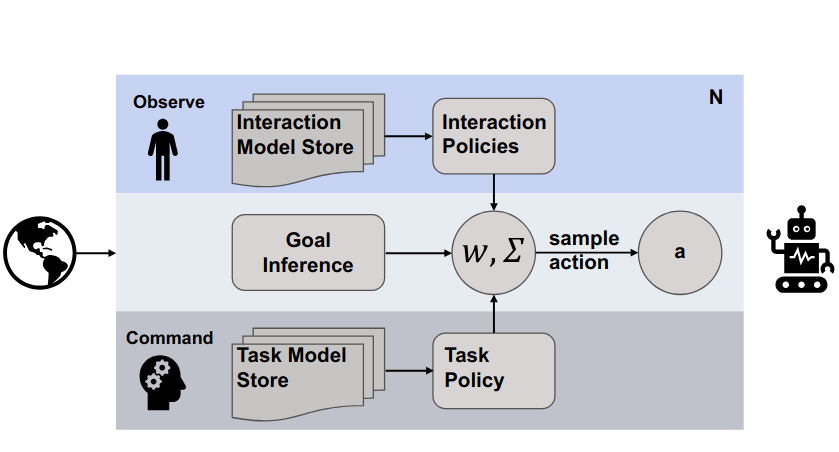
Research on multi-agent interaction involving humans is still in its infancy. Most approaches have focused on environments with collaborative human behavior or a small, defined set of situations. When deploying robots in human-inhabited environments in the future, the diversity of interactions surpasses the capabilities of pre-trained collaboration models. ”Coexistence” environments, characterized by agents with varying or partially aligned objectives, present a unique challenge for robotic collaboration. Traditional reinforcement learning methods fall short in these settings. These approaches lack the flexibility to adapt to changing agent counts or task requirements without undergoing retraining. Moreover, existing models do not adequately support scenarios where robots should exhibit helpful behavior toward others without compromising their primary goals. To tackle this issue, we introduce a novel framework that decomposes interaction and task-solving into separate learning problems and blends the resulting policies at inference time using a goal inference model for task estimation. We create impact-aware agents and linearly scale the cost of training agents with the number of agents and available tasks. To this end, a weighting function blending action distributions for individual interactions with the original task action distribution is proposed. To support our claims we demonstrate that our framework scales in task and agent count across several environments and considers collaboration opportunities when present. The new learning paradigm opens the path to more complex multi-robot, multi-human interactions.
2024
-
 An evaluation of situational autonomy for human-ai collaboration in a shared workspace settingVildan Salikutluk, Janik Schöpper, Franziska Herbert, Katrin Scheuermann, Eric Frodl, Dirk Balfanz, Frank Jäkel, and Dorothea KoertIn Proceedings of the 2024 CHI Conference on Human Factors in Computing Systems, 2024
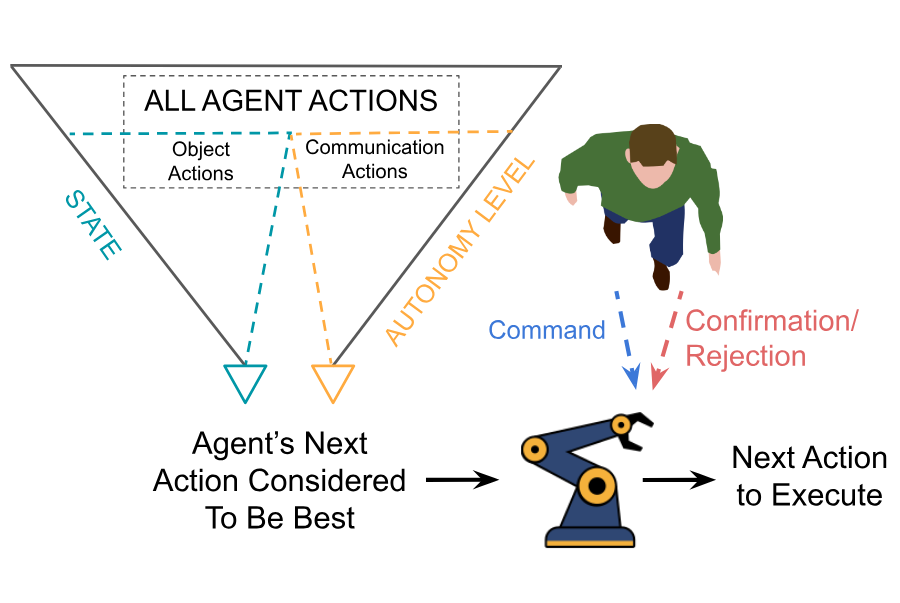
Designing interactions for human-AI teams (HATs) can be challenging due to an AI agent’s potential autonomy. Previous work suggests that higher autonomy does not always improve team performance, and situation-dependent autonomy adaptation might be benefcial. However, there is a lack of systematic empirical evaluations of such autonomy adaptation in human-AI interaction. Therefore, we propose a cooperative task in a simulated shared workspace to investigate efects of fxed levels of AI autonomy and situation-dependent autonomy adaptation on team performance and user satisfaction. We derive adaptation rules for AI autonomy from previous work and a pilot study. We implement these rule for our main experiment and fnd that team performance was best when humans collaborated with an agent adjusting its autonomy based on the situation. Additionally, users rated this agent highest in terms of perceived intelligence. From these results, we discuss the infuence of varying autonomy degrees on HATs in shared workspaces.
2022
-
 Interactive reinforcement learning with Bayesian fusion of multimodal adviceSusanne Trick, Franziska Herbert, Constantin A Rothkopf, and Dorothea KoertIEEE Robotics and Automation Letters, 2022
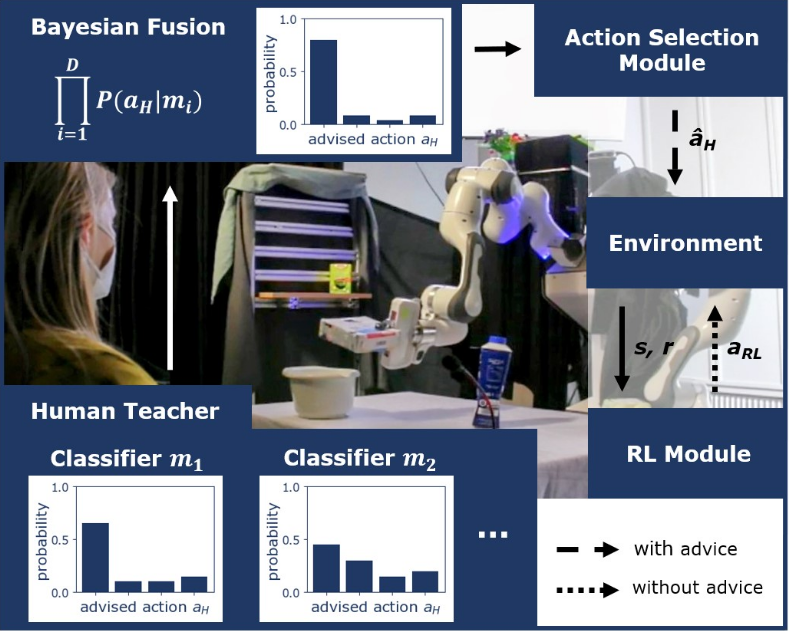
Interactive Reinforcement Learning (IRL) has shown promising results in decreasing the learning times of Reinforcement Learning algorithms by incorporating human feedback and advice. In particular, the integration of multimodal feedback channels such as speech and gestures into IRL systems can enable more versatile and natural interaction of everyday users. In this paper, we propose a novel approach to integrate human advice from multiple modalities into IRL algorithms. For each advice modality we assume an individual base classifier that outputs a categorical probability distribution and fuse these distributions using the Bayesian fusion method Independent Opinion Pool. While existing approaches rely on heuristic fusion, our Bayesian approach is theoretically founded and fully exploits the uncertainty represented in the distributions. Experimental evaluations in a simulated grid world scenario and on a real- world human-robot interaction task with a 7-DoF robot arm show that our method clearly outperforms the closest related approach for multimodal IRL. In particular, our novel approach is more robust against misclassifications of the modalities’ individual base classifiers.